
As we move through 2026, the tech landscape has shifted from simple conversational AI to something far more powerful: Autonomous AI Agents. For those of us working in System Administration, this isn’t just another buzzword—it’s a fundamental change in how we manage infrastructure, security, and cloud environments like Azure.
What Are Autonomous AI Agents?
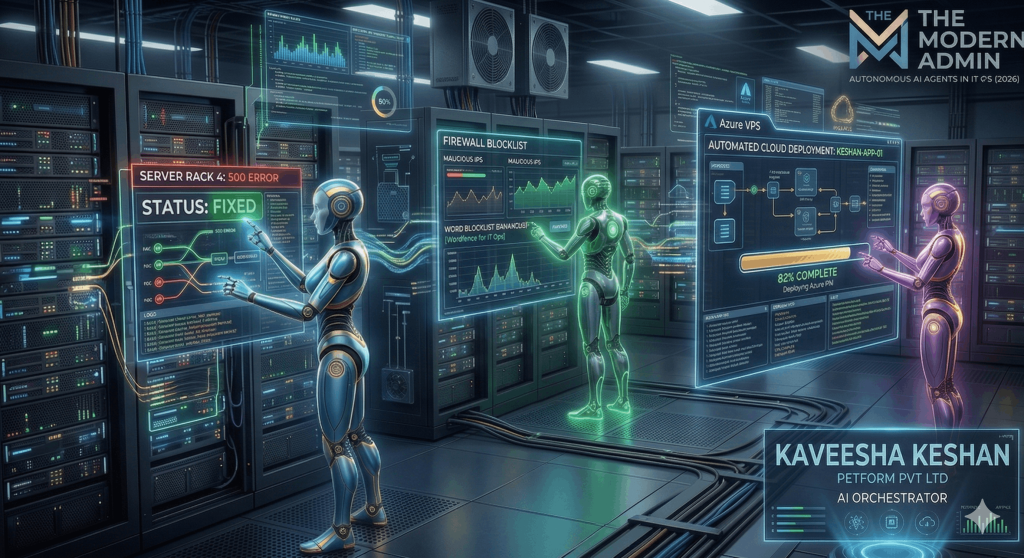
Unlike standard chatbots that simply answer questions, an Autonomous AI Agent is designed to achieve a goal. It can reason, use tools, and execute actions without constant human intervention. In an IT context, instead of asking an AI “How do I fix a 500 error?”, you give the Agent a goal: “Monitor my Apache server and resolve any downtime issues automatically.”
Key Use Cases for the Modern System Administrator
As a System Admin, I’ve seen how these agents reduce the burden of “manual toil.” Here are three ways AI agents are revolutionizing IT operations today:
- Self-Healing Infrastructure: Agents can monitor system metrics in real-time. If a service like MySQL crashes or RAM usage spikes, the agent can identify the root cause, clear caches, or restart services autonomously.
- Proactive Security Response: By integrating with tools like Wordfence or hardware firewalls, AI agents can detect sophisticated “low-and-slow” attacks that human eyes might miss. They can instantly update IP blocklists across an entire fleet of servers.
- Automated Log Analysis: Instead of manually grepping through gigabytes of logs, agents use Natural Language Processing (NLP) to find anomalies and suggest patches before a system failure occurs.
- Cost Optimization: In cloud environments like Azure, agents can monitor resource usage and automatically scale down underutilized VMs, saving companies thousands of dollars in monthly cloud bills.
Top 3 Autonomous AI Frameworks to Watch in 2026
To implement Autonomous AI Agents effectively, several frameworks have become industry standards in 2026. If you are a System Admin looking to start, keep an eye on these:
- AutoGPT 2.0: Excellent for multi-step tasks like software deployment and server patching. It allows for complex reasoning loops.
- Microsoft AutoGen: Perfectly integrates with Azure environments for complex cloud orchestration. It allows multiple agents to talk to each other to solve a problem.
- BabyAGI Next: A lightweight framework ideal for edge computing and local VPS monitoring where resources are limited.
Implementation: Running an AI Agent on an Azure VPS
Hosting your own AI management layer is surprisingly straightforward using an Azure VPS (Ubuntu). By leveraging APIs from providers like OpenRouter or DeepSeek, you can deploy lightweight scripts that act as your 24/7 virtual assistant.
Here is a conceptual Python snippet of an agent that monitors server health:
import os
import openai

# Connecting to the AI Model via API
client = openai.OpenAI(api_key="YOUR_SECURE_API_KEY")

def autonomous_monitor():
    # Check current system load
    load_avg = os.getloadavg()[0]

    if load_avg > 1.5:
        print(f"Warning: High load detected ({load_avg}). Consulting AI Agent...")

        prompt = f"The server load average is {load_avg}. Suggest a bash command to identify the culprit process."

        response = client.chat.completions.create(
            model="gpt-4o",
            messages=[{"role": "user", "content": prompt}]
        )
        print("AI Suggestion:", response.choices[0].message.content)

if __name__ == "__main__":
    autonomous_monitor()
Challenges and Ethical Considerations
While Autonomous AI Agents offer incredible efficiency, they come with risks. “Hallucinations”—where an AI makes a wrong decision—can lead to server misconfigurations. As admins, we must implement “Human-in-the-loop” (HITL) safeguards, especially for critical production databases. We must also ensure that AI agents have restricted permissions (Least Privilege) to prevent them from accidentally deleting vital data
The Future: From Admin to Orchestrator
In 2026, the role of the System Administrator is evolving. We are moving away from being “firefighters” and becoming AI Orchestrators. Our job is now to design the systems, set the guardrails, and manage the AI agents that handle the day-to-day operations.
For any professional in the field, staying updated with AI integration is no longer optional—it is the core of the Modern Admin identity. Staying ahead of the curve means mastering these autonomous tools to build a more resilient digital world.
Pingback: 20 Essential Linux Terminal Shortcuts for SysAdmins - ThreatMe - The Modern Admin